

Mr. Holland's Opus tells the story of a high school music teacher who fails to realize all the ways he's touched his students' lives through his decades-long career, of how the job he had once reluctantly accepted as a fallback option becomes his main priority while his dream of writing a truly immortal composition becomes more and more distant.
The movie beautifully brings out the greatest irony of Mr. Holland’s life in the form of the deafness of his son and the consequent effect on his life. The disappointment, frustration gives way to angry outbursts and tension between the two. But all is resolved when Glenn Holland learns to sign John Lennon's song, “Beautiful Boy,” and dedicates it to his son, emphasizing the line about how “Life is what happens while you're busy making other plans.”
But what cuts through all of this and makes the film not just watchable but quite enjoyable is the excellent performance delivered by Richard Dreyfuss. He seems perfect - and his aging makeup is quite remarkable.
The passage of time is beautifully denoted by using archival-footage (with references to everything from the Kennedy assassination to the Vietnam War to Watergate and Nixon's resignation) and musical montages.
The film’s got a brilliant score composed by Michael Kamen. The most remarkable feature of the score is way it blends so perfectly with the film. It effortlessly integrates with the film, highlighting the different emotions and transitions Mr. Holland goes through.
Dead Poets' Society told a similar story in a similar setting with similar themes, but Mr. Holland's Opus steers ahead of it in many aspects.
A symphony of great screenplay, strong performances and good vibes, Mr. Holland’s Opus affirms my believe that a life spent in a worthy pursuit, is a life well spent.
Showing posts with label cinema. Show all posts

Set in the 1993 civil war in Bosnia (Former Yugoslavia), No Man’s Land is the story of 3 soldiers trapped between the enemy lines. Chiki a Bosnian soldier has taken refuge in the trench after all of his comrades were massacred by the Serbian soldiers. He manages to kill one of two Serb scouts sent to investigate and has a standoff with the other, Nino. One of Chiki's fallen comrades, badly wounded but still alive, is paralyzed by the bouncing mine placed under him by the Serb soldiers. UN forces are called in and the media caravan comes along. There is now more world focus on getting three guys out of the trench than on the war which placed them there.
The movie opens in the midst of a dense fog - an apt metaphor for the chaos that reigned within the two countries. After the initial rounds of combat and attempts at gaining the upper hand, a shaky truce is established between the two. Once trapped inside the trench, the two soldiers discover that waving white flags only draws fire from both the sides.
The director brilliantly portrays the futility of the war through the conversation of the two soldiers who while talking about the peaceful times find out that they both knew the same girl. And even though they talk, they never really warm up to each other, they still do not have any solidarity for the other the hatred and contempt being very deep rooted.
The film also beautifully 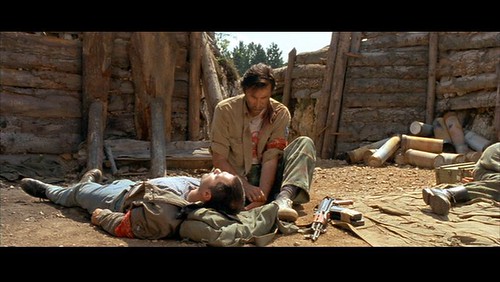 portrays the bond Cera (the Bosnian soldier paralyzed by the bouncing mine) and Chiki share. Chiki is willing to go to any lengths to save his compatriot’s life even it means risking his own. He defiantly refuses to leave the trench without Cera. Cera on other hand is well aware of his helpless situation and urges Chiki to leave.
This little conversation between them was particularly very heart –wrenching. Cera: I hope those aren't my cigarettes. Chiki: When I took them, I didn't know you'd need them. But now I hope . . .
[lighting one up and taking a drag, then putting it into Cera's mouth] Chiki: that you'll die of cancer. Again the director has effectively used the precarious situation of Cera to symbolize the political conundrum of the country. The other aspect of No Man’s Land is about the role of UN and media. Tanovic takes a condemning view of the United Nations' bungling ways and how the media manipulates, and is manipulated by, the military. Though Sergeant Marchand from the UN forces is determined to save those trapped in the trenches he is unable to do so because his hierarchical seniors are a bunch of ludicrous people who can’t take any concrete decisions.  Then enters the media who desperately want to get the live “bites” from the battlefield. The media ensures that within no time the incident is escalated to international proportions. This finally prompts the UN officials to send their troops along with a bomb defusing expert and the media of course. As they await the prognosis of the bomb diffusing expert, the media sets about questioning the soldiers.
This cold behavior of the journalists combined with his inability to help his friend angers Chiki and pushes him into violence ultimately killing Nino.
No Man's Land poses some disturbing questions about the nature of hatred and the wars it spawns. . No Man's Land presents a balanced and devastatingly accurate look at the Serbia- Bosnia conflict, strongly condemning the policies of the (western nations dominating) UN.
With it’s rich tapestry of characters, dark humor and violence all combined with an engaging story, No Man’s Land is truly one of the best anti-war films.


